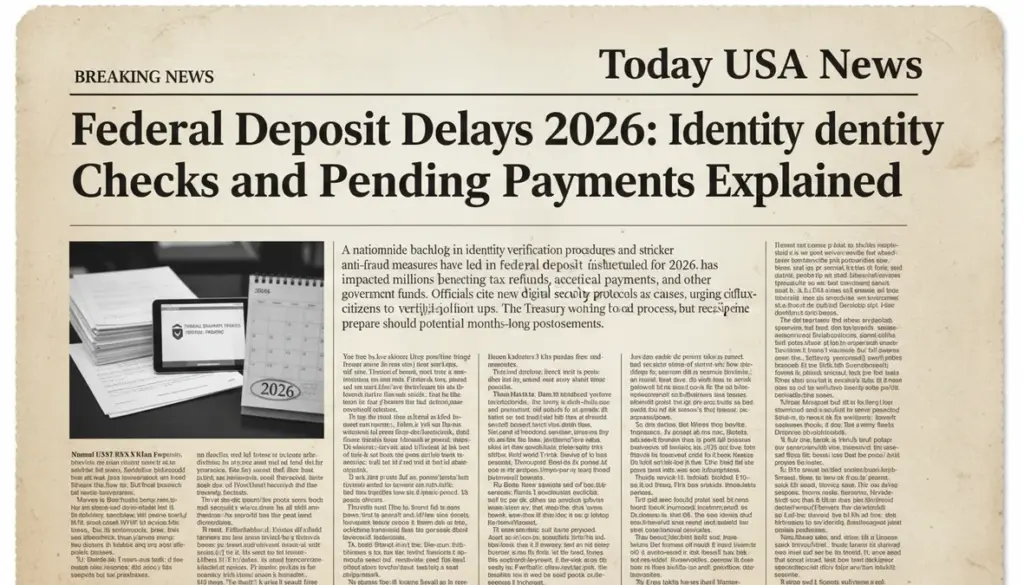
Federal Deposit Delays 2026: Across the United States, early 2026 has brought an unexpected pause for thousands of households waiting on federal deposits. Payments that many assumed would arrive automatically often ranging between $2,000 and $3,000 are instead appearing as “pending” or delayed in bank accounts. For families already juggling rising rents, insurance premiums, and everyday costs, even a short delay can feel unsettling. Yet officials insist this is not a funding crisis or a sudden policy reversal.
The real reason lies deeper inside the government’s payment systems. Federal agencies have quietly expanded identity verification protocols, aiming to curb fraud and prevent money from landing in the wrong hands. These checks, though largely invisible to recipients, have slowed down deposits that would have cleared within hours in previous years. Understanding why these holds exist and why they are more common in 2026—offers important clarity for anyone waiting on federal funds.
The Push for Tighter Identity Verification
Over the past decade, federal payment systems have become faster and more automated. Ironically, that speed has also attracted fraudsters. According to public audit reports, attempted identity-based fraud linked to government payments rose sharply after pandemic-era relief programmes. In response, agencies began layering more safeguards onto existing systems, culminating in the stricter checks now seen in 2026.
These verifications do not only target suspicious cases. Even routine filings can be flagged if small inconsistencies appear. A shortened name, a missing middle initial, or a recently updated address can trigger a temporary hold. As former Treasury compliance advisor Michael Rowan explains, “The system is designed to pause first and ask questions later. It’s frustrating, but it’s also how billions in losses are being avoided.”

Why Mid-Sized Federal Payments Face More Scrutiny
Not all deposits are treated equally. Smaller, recurring payments often pass through automated checks without interruption. Larger sums—especially those between $2,000 and $3,000 tend to involve multiple components, such as tax credits, adjustments, or backdated benefits. Each component must align perfectly before the total is released.
This layered calculation increases the chance of a pause. If one element requires manual confirmation, the entire payment is temporarily held. Officials stress that this does not indicate rejection. Historically, similar reviews occurred during earlier tax seasons, but in 2026 the scope has widened. The difference now is scale: far more accounts are undergoing the same careful validation at once.
Banking and Personal Updates: A Common Trigger
One recurring theme among delayed recipients is recent change. Switching banks, updating routing numbers, or even correcting a typo in personal information can activate additional checks. While these updates are necessary, they also signal the system to slow down and confirm authenticity.

Address changes and filing status corrections can have the same effect. In previous years, such updates might have gone unnoticed. Today, they are cross-checked against multiple databases. “From a policy standpoint, this is preventative,” says financial policy analyst Dr. Lena Morales. “From a citizen’s perspective, it feels like the system suddenly forgot who you are.” Both views, she notes, are simultaneously true.

Why Online Trackers Offer Limited Clarity
For many recipients, the most confusing aspect is the lack of explanation. Online payment trackers often show vague statuses like “processing” or “pending,” without detail. This opacity fuels anxiety, especially when days pass with no visible change.
The reason is structural. Trackers are designed for broad updates, not internal compliance steps. When a payment enters a verification loop, the system does not always generate a public-facing message. As a result, deposits may appear stagnant before suddenly clearing. Past data suggests most identity holds resolve quietly, without further action from the recipient.
Security Versus Speed: A Policy Trade-Off
From a governance perspective, the delays reflect a conscious trade-off. Federal agencies are prioritising accuracy over speed, even at the cost of public frustration. With public funds under increasing scrutiny, preventing a single large-scale error can justify thousands of small delays.
Comparatively, earlier programmes such as emergency pandemic payments favoured speed, sometimes at the expense of verification. Those programmes later faced criticism for improper payouts. In 2026, policymakers appear determined not to repeat that experience. The result is a slower but more controlled release of funds.
Public Reaction and Short-Term Impact
Public response has been mixed. Some recipients express understanding, acknowledging the need for safeguards. Others argue that the burden of fraud prevention has shifted unfairly onto ordinary citizens. Online forums and social media reflect both sentiments, often within the same discussion.

Economically, short delays rarely alter long-term outcomes, but they can disrupt short-term planning. Households relying on refunds or credits for specific expenses may need to adjust timelines. Financial counsellors advise caution rather than repeated account changes, noting that unnecessary edits can prolong reviews instead of resolving them.
What Happens Next in 2026
Looking ahead, experts expect verification protocols to remain strict throughout the year. As systems adapt, average review times may shorten, but the underlying checks are unlikely to disappear. Agencies are also exploring clearer communication tools to explain delays without compromising security.
For recipients, the key takeaway is patience paired with consistency. Most holds clear within a few business days, and funds typically arrive soon after. While the process may feel opaque, it reflects a broader shift in how governments balance efficiency with accountability in an era of digital finance.
Disclaimer: This article is intended for informational and journalistic purposes only. It does not constitute financial, legal, or government benefit advice. Federal payment processing timelines, verification requirements, and deposit schedules can vary based on individual circumstances and policy changes. Readers are advised to consult official government notices, agency communications, or authorised websites for accurate and up-to-date information regarding their payments.