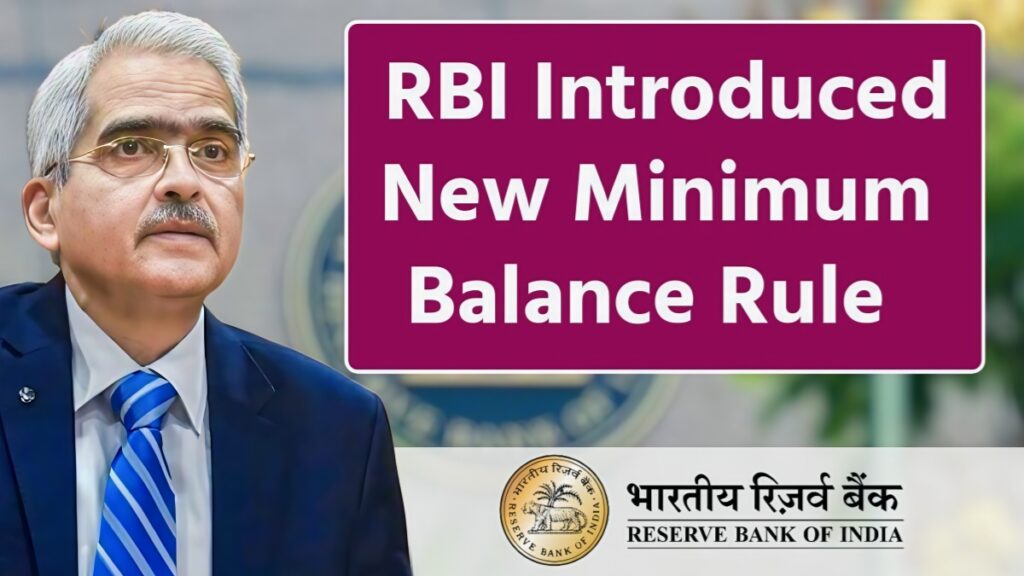
RBI Minimum Balance Update 2026: The RBI Minimum Balance Update 2026 has arrived quietly, without the drama of a sweeping notification or late-night press briefing. Yet, its implications are rippling through India’s banking system in ways that touch daily life far more directly than many headline-grabbing reforms. For millions of savings account holders, minimum balance rules have long been an invisible source of anxiety. A medical emergency, a delayed salary, or a failed crop season could mean dipping below the required threshold and triggering an automatic penalty that felt both sudden and unfair.
Over time, these deductions chipped away at trust. Customers often noticed them only after the fact, buried in bank statements or SMS alerts. The RBI Minimum Balance Update 2026 reflects a shift in regulatory thinking one that recognises banking as a public utility as much as a commercial service. By pressing banks to relax penalties, reassess balance limits, and communicate more clearly, the central bank is attempting to realign everyday banking with real-world income patterns, especially for vulnerable and irregular earners.
Why Minimum Balance Rules Became a Flashpoint
Minimum balance requirements were originally framed as a way to encourage account discipline and cover servicing costs. Over the years, however, they evolved into a steady source of fee income for banks, particularly in urban branches. Customer complaints began to pile up. Ombudsman data repeatedly highlighted grievances about unexplained deductions, with many customers claiming they were never clearly informed of the applicable limits or penalties.
More troubling for regulators was the unintended fallout. In rural and semi-urban India, fear of penalties led people to keep accounts dormant or withdraw money immediately after receiving government transfers. A retired RBI official familiar with inclusion programmes once remarked that “an account people are afraid to use is no account at all.” The RBI Minimum Balance Update 2026 is rooted in this realisation that rigid rules were undermining the very goal of expanding formal banking.

No-Penalty Push Changes the Banking Tone
At the heart of the RBI Minimum Balance Update 2026 is a strong discouragement of automatic penalties, especially for basic savings and inclusion-linked accounts. While the central bank has stopped short of banning minimum balance norms outright, it has made it clear that blanket deductions without adequate warning or flexibility are no longer acceptable. Several public sector banks have already responded by scrapping penalties for entry-level savings accounts.
This subtle shift carries weight. A daily wage labourer whose balance dips for a few weeks is no longer instantly punished. Pensioners drawing modest monthly amounts get room to manage expenses without fearing erosion of their savings. According to banking analyst R. K. Malhotra, “The regulator is telling banks that continuity of usage matters more than extracting small fees. That’s a philosophical change.”
Revised Balance Limits Reflect Economic Reality
Another significant aspect of the RBI Minimum Balance Update 2026 is the encouragement to recalibrate balance thresholds based on geography and account type. Earlier, many banks applied similar minimum balance expectations across urban and rural branches, despite stark differences in income stability and living costs. Under the updated framework, banks have quietly lowered requirements for rural and semi-urban accounts.

This flexibility acknowledges a simple truth: ₹2,000 or ₹3,000 means very different things in different contexts. For a salaried metro resident, it may be manageable. For a small farmer or informal worker, it can be unrealistic. By allowing differentiated norms, RBI is reducing pressure on customers and, incidentally, on banks that previously relied on penalties to offset low-balance accounts.
Rural and Small-Town Customers Feel the Shift First
In villages and small towns, the RBI Minimum Balance Update 2026 is already altering behaviour. Accounts that were earlier used only to receive subsidies or pensions are now more likely to stay active. With less fear of penalties, customers are leaving modest balances untouched instead of withdrawing every rupee immediately after a credit.
This has broader policy implications. Active accounts improve the efficiency of welfare delivery and reduce leakage. Economists tracking financial inclusion note that relaxed norms could lower dormancy rates significantly. As one field researcher in Bihar observed, “People trust the system more when it doesn’t punish them for being poor or seasonal earners.”

Urban Customers Get Transparency, Not Free Passes
For urban and higher-income customers, the changes are more about clarity than concessions. Salary and premium accounts continue to carry balance expectations, but banks are now under pressure to disclose charges clearly and send alerts before penalties are imposed. Surprise deductions are becoming harder to justify under the new regulatory mood.
This transparency empowers customers to make informed choices whether that means switching to a zero-balance account, consolidating multiple savings accounts, or negotiating account terms. Over time, industry observers believe this could push banks to compete more on service quality and less on opaque fee structures, subtly reshaping retail banking dynamics.
Digital Banking Gains an Unexpected Boost
The RBI Minimum Balance Update 2026 may also accelerate digital adoption in indirect ways. When customers worry less about maintaining exact balances, they are more comfortable using UPI, mobile banking apps, and online transfers. Reduced anxiety translates into higher confidence, especially among first-time digital users who previously feared making “mistakes” that could cost them money.
Looking ahead, policy watchers expect RBI to closely track how banks implement these guidelines. If gaps persist, further standardisation or stricter disclosure norms may follow. For now, the update signals a regulator willing to prioritise usability over punishment a notable evolution in India’s banking philosophy.
What Comes Next for Account Holders
The full impact of the RBI Minimum Balance Update 2026 will unfold over time, varying by bank and account category. Customers are already being advised to review revised terms, as not all institutions have moved at the same pace. Private banks, in particular, may take a more cautious approach while adjusting their fee models.
Still, the direction is clear. Banking is being nudged toward empathy and realism, without dismantling commercial logic entirely. For ordinary account holders, that balance between discipline and dignity could make all the difference in how they relate to the financial system.
Disclaimer: This article is based on publicly available information, regulatory guidance, and industry analysis related to the RBI Minimum Balance Update 2026. Banking rules and charges may vary depending on the bank, account type, and location. Readers are advised to consult their respective banks or official Reserve Bank of India communications for the most accurate and current details. This content is intended for informational purposes only and does not constitute financial or legal advice.